The Experiential Tier, or, How Apple Solved the Mature Smartphone
 ·
·
4 min read
Most commentary about Apple’s iPhone strategy bemoans its apparent lack of novelty. I think Apple may have quietly taken that feedback to heart, but not in the way people expect. Rather than trying to make the iPhone itself dramatically different every year, Apple seems to be treating the smartphone as what it increasingly is: a mature product category where the basic problem is largely solved and the return on radical changes to the mainstream product is relatively low.
Unlike the 2021 MacBook Pro overhauls where Apple recognized that pushing thin-and-light laptop design to its extremes had become detrimental to the user experience, for most people, the smartphone is already an extremely mature product. The average buyer isn’t comparing camera sensor sizes or debating the merits of one processor architecture over another. They know Apple makes a good phone, they know people around them use iPhones, and when they decide to buy one, the Pro is an easy recommendation if they want the best version of the thing they already understand. If they don’t care as much about cameras and other bells and whistles, there is a standard model that does essentially everything they need. Apple maintains that the flagship iPhone isn’t designed to surprise people. It is intended to keep the product competitive, reliable, familiar, and good enough that there is very little reason to leave it. It might not be as exciting as the early days when they had a backlog of ideas to work through, but radical new designs introduce risk, disrupt people’s expectations, complicate manufacturing and support, and potentially make an otherwise excellent product worse.
But after the most recent iPhone Duo announcement, I started to think back to Steve Jobs’s famous 2x2 product matrix. (When Jobs returned to Apple, one of the first things he did was drastically simplify the company’s product lineup into a small number of clearly defined products: consumer and professional, desktop and portable.) The strategy was a form of redlining where each product had to justify who it was intended for. A second 2x2 was created when the iPhone and iPad were introduced, and Apple has mostly stuck to that strategy for the past 25 years.
Phones have become the prevailing personal computing paradigm, and Apple is no longer the struggling company that it once was. They have enough room and enough scale to create a category specifically for things that are allowed to be different.
A new version of that matrix in the iPhone lineup seems to be emerging:
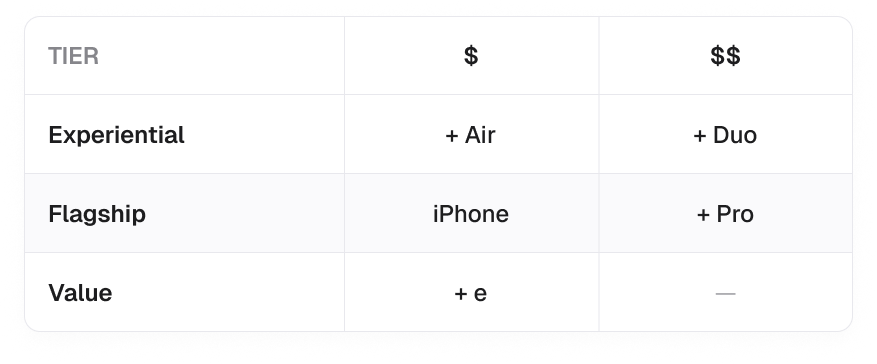
By adding a new dimension to the matrix, Apple is able to address a historical advantage of Android: it is much more comfortable with experimentation. A folding screen, a bizarre camera system, a stylus, some new form factor, some ridiculous specification—those draws become considerably less compelling if Apple can provide that same experimentation without requiring people to leave the iPhone ecosystem. The iPhone can remain conventional, the Pro can remain the best possible version of that conventional phone, and products like the Air and Duo can act as controlled experiments in what the iPhone might become next.
There is an interesting wrinkle at the value end of the lineup, though. The iPhone 17e starts at $699, while Apple continues to sell the older iPhone 16 for $799. The 17e is newer, but deliberately stripped down to hit a lower price; the 16 is older, but remains a more capable version of the conventional iPhone. It’s a good illustration of how awkward it becomes to make a product matrix out of discrete SKUs once price, age, capability, and features all start moving independently.
Rather than maintaining a collection of increasingly arbitrary compromises, Apple could make the phone itself configurable within the same basic chassis. An enterprise or education customer buying thousands of devices probably doesn’t need the highest-end camera system, maximum storage, or every component Apple can possibly fit into a phone. A configurator could let those customers deliberately down-spec the hardware while preserving the same fundamental product and software experience. It would also give individual customers who simply don’t care about the latest hardware a way to buy less phone without having to buy something that feels like a different class of product.
Ultimately, capturing the next phase of the smartphone market isn’t about matching Android’s chaotic approach to novelty. By structuralizing experimentation through the Air and Duo, and resolving the pricing friction of the lower end through a configurable chassis, Apple can preserve the reliability of its flagship while turning a mature product category into an unassailable platform.